· 8 min read · By Hotsolar engineering team
More and more people ask whether they can put a battery in their home without having solar panels. The short answer is yes: the battery charges from the grid during cheap hours and the house uses it during expensive ones, or keeps it for when the power goes out. If you install it only to save money, at today's prices it takes about 20 years to pay for itself, twice the usual warranty. It makes sense if what you want is backup for power cuts, if you can't fit panels, or as a first step before adding them.
How a battery works without panels
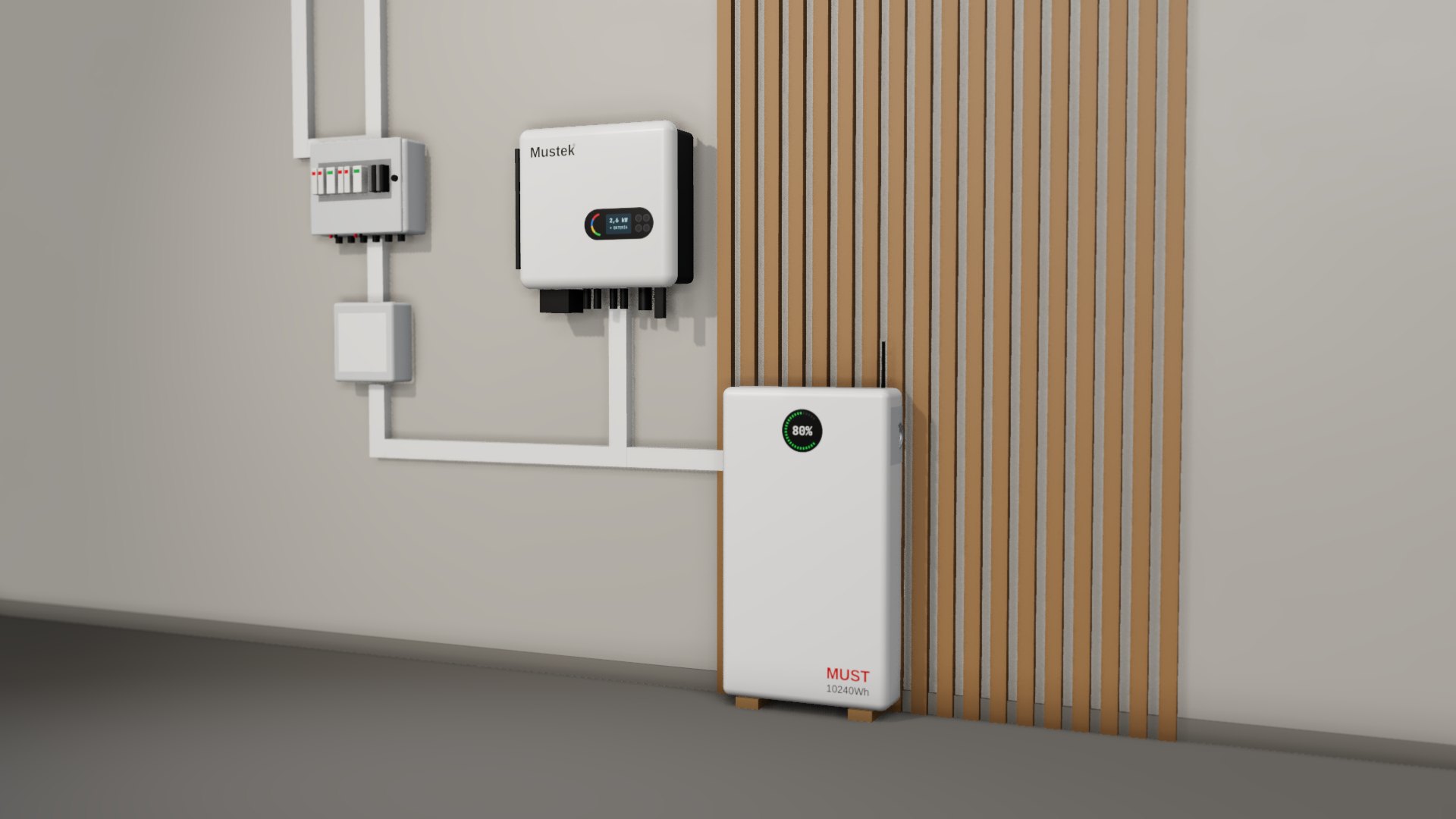
You need an inverter that can charge the battery from the grid: a hybrid inverter, or a battery inverter connected to the home's wiring. It's programmed to charge in the early hours, when electricity is cheapest, and to let the house draw from the battery during the expensive hours.
For it to pay, you need a tariff with different prices by time of day. With the 2.0TD tariff, which almost all Spanish homes have, the day is split like this:
| Period | Monday to Friday | Weekends and national holidays |
|---|---|---|
| Peak (most expensive) | 10 to 14 h and 18 to 22 h | None |
| Mid | 8 to 10 h, 14 to 18 h and 22 to 24 h | None |
| Off-peak (cheapest) | 0 to 8 h | All day |
Mainland Spain hours. If your tariff has the same price 24 hours a day, a battery without panels saves you nothing.
The numbers: how much it saves and when it pays back
On three-period tariffs in the free market, the gap between peak and off-peak is around 10 cents per kWh. For example, one October 2026 tariff charged €0.229/kWh at peak and €0.129/kWh off-peak, before tax. With the regulated PVPC tariff the gap changes every day and is sometimes larger.
An example with a 10 kWh battery:
- In the early hours you buy 10 kWh off-peak, about €1.30.
- Charging and discharging loses around 10 %, so you're left with about 9 kWh to use.
- Those 9 kWh at peak would have cost you about €2.05. You save about €0.75 a day.
- This only happens on weekdays, because weekends are all off-peak: about 250 days a year, between €190 and €260 a year depending on the tariff.
And that's if your home uses 9 kWh during peak hours, which is a lot for an average household. If you use less, you save less.
Now the cost. A system like this, with a hybrid inverter, a 10 kWh battery, labour and paperwork, comes to around €4,400: about €900 for the inverter, about €2,500 for the battery and about €1,000 for installation and legalisation. With €190 to €260 saved a year, it would take 17 to 23 years to pay back, about 20. Without panels the battery only does about 250 cycles a year, so it can last a long time, but the warranty is usually 10 years. On savings alone, it doesn't pay off.
Rough calculation with 2026 prices. It depends on your tariff, how much you use in each period and the price of your equipment.
With panels, the same battery changes the numbers
With panels, the battery isn't filled with bought electricity but with the solar power you have left over at midday. If you don't store that energy, it goes to the grid and you get a credit on your bill of about 5 to 8 cents per kWh. If you store it, you use it in the evening and at night instead of buying electricity at 20 or 25 cents.
So each stored kWh is worth more, the battery also works at weekends, and you need the hybrid inverter for the panels anyway. With the same 9 kWh a day, the battery can save around €400 a year. Since the inverter and much of the installation are already paid for by the panels, what the battery adds is around €3,000, and it pays back in about 7 to 8 years, within the warranty. The panels pay back even sooner, as we explain in our article on how much solar panels save in Andalucía.
| Battery without panels | Battery with panels | |
|---|---|---|
| Where the energy comes from | The grid, at off-peak hours | Your leftover solar |
| Days it works | Weekdays | Every day, especially sunny ones |
| Battery savings (10 kWh) | About €190 to €260 a year | About €400 a year |
| Pays back in | About 20 years | About 7 to 8 years |
| Backup in a power cut | Yes, with a backup output | Yes, and it recharges with the sun |
Guide values with a 10 kWh battery, 2026 electricity prices and a system costing about €4,400 installed.
When a battery without panels does make sense
If you want backup for power cuts. Since the blackout of 28 April 2025 many people ask for this, and here the question isn't about savings. With the inverter's backup output, the battery keeps the fridge, lights, router or water pump running for hours. We explain it in our article on the 20 % reserve.
If you can't put panels on your home. A flat with no roof of its own, a building that won't give permission, or a roof in heavy shade. The battery gives you backup and some savings by shifting use to off-peak hours.
If you plan to add panels later. With a hybrid inverter, you fit the battery today and just add the panels tomorrow. Nothing else has to change.
If you use a lot of power at peak times. Air conditioning in the afternoon, an electric cooker, or an electric car charging at midday. The more use you can shift from peak to off-peak, the better the numbers look, although payback is still long.
What the rules say
There is no specific rule for home batteries without panels. Royal Decree 244/2019 regulates storage as part of self-consumption, and the industry is asking for the new self-consumption and storage decree to also cover batteries that only charge from the grid.
In practice, a home battery is a low-voltage electrical installation. That means:
- It has to be fitted by an authorised installer, with an electrical installation certificate (the "boletín") registered with the regional government.
- The inverter and battery must carry the CE mark and meet grid connection standards.
- The battery must not export energy to the grid. The inverter is set to zero export.
- Charging has to stay within your contracted power. If you charge at high power in the early hours with other appliances on, the limiter can trip. The inverter lets you cap the charging power.
- To have power during a blackout, you need a backup output that isolates your home from the grid.
As the rules may change, ask your installer how it's processed in your region before you buy.
Frequently asked questions
Can I sell the energy stored in the battery to the grid? No. A home can't charge from the grid when it's cheap and sell when it's expensive. The battery's energy is for your own use.
Can I add panels later? Yes, if you choose a hybrid inverter from the start. You just add the panels and the battery starts filling with solar too.
How many hours will it give me in a power cut? With a full 10 kWh battery, the basics (fridge, router and a few lights) last well over a day. If it's sitting at a 20 % reserve, about 12 to 18 hours.
Does it work in a flat? Yes, if you have room for the battery and inverter near the consumer unit, in the shade and ventilated. You don't need a roof or the building's permission for the battery, but you do need the installer's certificate.
Thinking about a battery?
Tell us what tariff you have, how much you use and whether you can fit panels, and we'll tell you whether a battery on its own or with panels makes more sense for you. More information on our batteries page, or message us on WhatsApp with the word BATTERY.
Sources
- Guiavatio: 2.0TD tariff time periods in 2026 (in Spanish)
- Xataka Home: electricity tariffs for October 2026, with peak, mid and off-peak prices (in Spanish)
- El Español: engineer Javier Dasí on charging a battery at cheap hours without panels (in Spanish)
- El Español: what it takes to legalise a home battery (in Spanish)