· 5 min read · By Hotsolar engineering team
If you have solar panels with a battery, you use it every day: it fills up with the sun and you drain it at night. It's natural to wonder whether that much use will wear it out in a few years. The short answer is no. A home lithium iron phosphate battery is built to work this way. What shortens its life is something else, and most of it comes down to where it's installed and how the inverter is set up.
What's inside a home battery
Most home batteries sold today use lithium iron phosphate cells, also called LFP or LiFePO4. Each cell works at about 3.2 volts. Inside a "48 V" battery there are 16 cells connected in series: 16 × 3.2 = 51.2 V, which is the nominal voltage you'll see on the datasheet.
On top of the cells sits the BMS, the battery management system. It measures the voltage, current and temperature of every cell and stops charging or discharging if anything goes outside its limits. It also balances the cells: when one fills up before the others, the BMS holds it back and lets the rest catch up, so no cell is pushed too hard.
How many cycles it lasts
One cycle is one full charge and discharge. If the battery fills during the day and empties at night, that's roughly one cycle a day, about 365 a year.
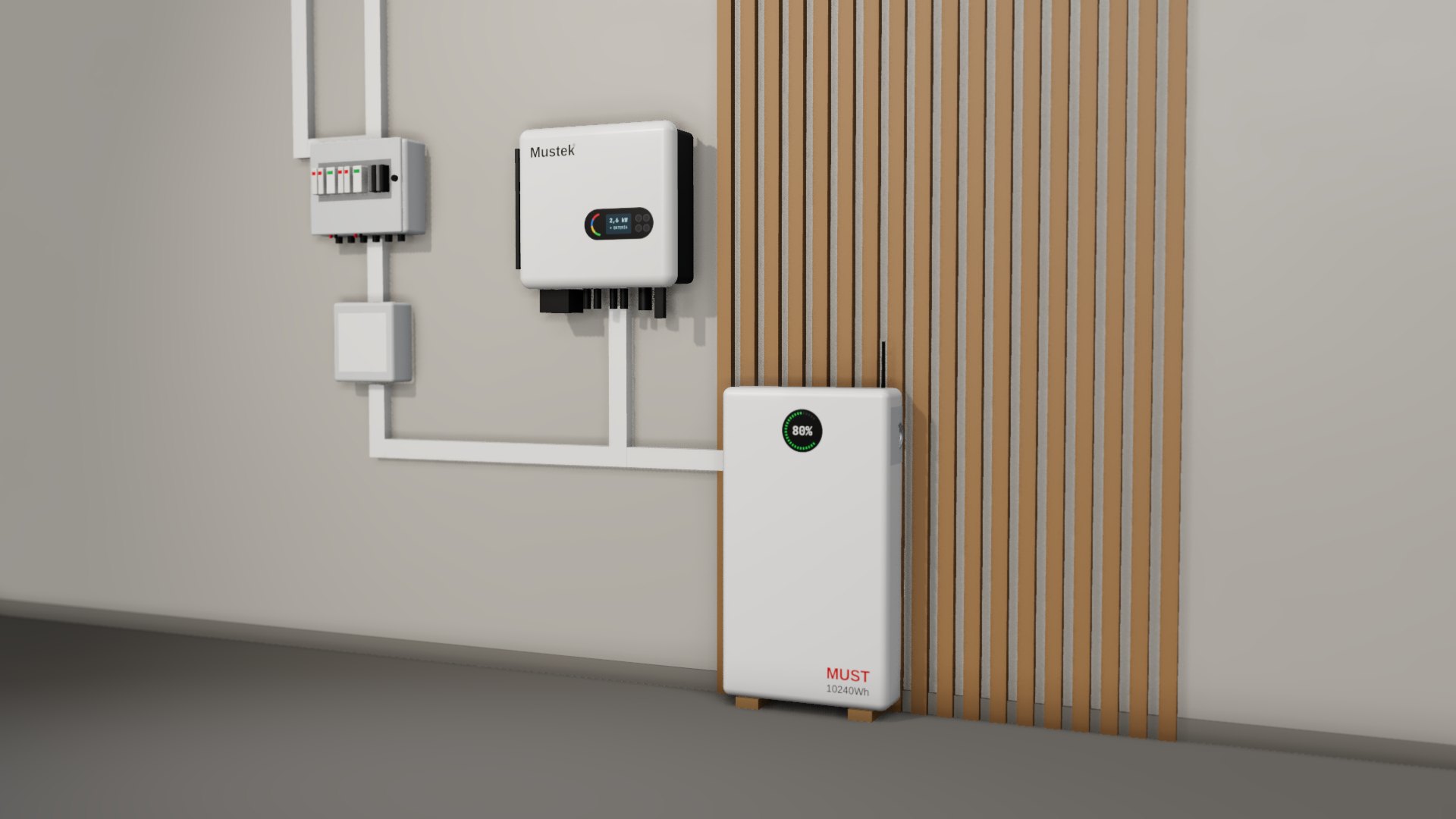
Many datasheets for home LFP batteries quote more than 6,000 cycles. The MUST LP2800 series, for example, which we install in 5, 10 and 15 kWh versions, states more than 6,000 cycles at 80 % depth of discharge and 25 °C, with a 10-year warranty.
Do the maths: 6,000 cycles at one a day is more than 16 years.
| Use | Cycles per year | Years to reach 6,000 cycles |
|---|---|---|
| One cycle a day | 365 | about 16 |
| Half a cycle a day (winter, cloudy days) | about 180 | more than 30 |
Rough figures. The 6,000 cycles are measured in a lab at 25 °C; real life at home depends on temperature and use.
What really wears it out
Heat
Heat ages a lithium battery faster than anything else. A battery in a garage that gets direct sun, or in an unventilated storeroom that goes above 35 °C in August, loses capacity much faster than one installed somewhere cool.
That's why manufacturers ask for batteries to be installed in the shade. The MUST LP2800 datasheet, for example, allows indoor or outdoor installation "without sunlight exposure" and gives a storage temperature of -5 to 35 °C. With Seville's summers, this is worth taking seriously.
Weeks at 100 % without use
A full battery that just sits there also ages, even without cycling. This is called calendar ageing, and it speeds up the higher the charge and the hotter it is. A 2025 study on LFP cells found that cells stored at 75 % aged more than cells stored at 50 % at high temperature. The authors recommend leaving them between 40 and 60 % when they won't be used for a while.
The typical case is going on summer holiday with the battery at 100 % in a hot garage.
Draining it to 0 %
Emptying it completely, again and again, is also hard on it, so the BMS and the inverter cut off before it reaches truly empty.
How the inverter protects it
A well-configured hybrid inverter avoids the extremes without you doing anything. It can stop charging before 100 % (at 95 %, for example) and won't let the house drain the battery below a minimum. It can also keep a reserve, say 20 %, that is only used during a power cut.
We set these when we install the system, based on your consumption and how much backup you want for outages.
Tips to make your battery last longer
- Install it in the shade and somewhere ventilated. An indoor garage or a plant room usually works well; a loft under the roof doesn't.
- Don't cover it or stack things on it that block ventilation.
- If you're away for several weeks, lower the charge limit so it doesn't sit at 100 % the whole time.
- Keep a reserve for power cuts, but don't overdo it: a very high reserve takes usable capacity away every day.
- Check the battery or inverter app now and then. If a cell or the temperature raises a warning, you'll see it there.
Frequently asked questions
Is charging it to 100 % bad? Not if it reaches 100 % on a given day. What wears it out is staying at 100 % for many days in a row, especially in the heat.
How many years does a home battery last? At one cycle a day, an LFP battery rated for more than 6,000 cycles can last over 15 years. The usual warranty is 10 years.
What about the cold? In Andalucía it's rarely an issue. LFP batteries don't charge below 0 °C, and the BMS blocks it to protect them.
Does the battery lose capacity over time? Yes, gradually. Warranties usually guarantee that it keeps a large share of its capacity after a set number of years; check the exact figure in your model's warranty.
Questions about your battery?
If you already have a battery and aren't sure it's installed or configured properly, we'll check it. If you're thinking of getting one, we'll help you choose the capacity and where to put it. More on our batteries page, or message us on WhatsApp with the word BATTERY.